WhatsApp Payment Reminders for B2B Invoices
Chasing overdue invoices by email is slow and easy to ignore. A five-stage WhatsApp reminder ladder that gets paid without damaging the client relationship.
Late payment is a cash flow problem before it is an accounting one. For Indian SMBs working with larger buyers, 60 and 90 day delays are routine, and the standard response — an emailed reminder into an unread inbox — rarely changes anything.
WhatsApp works better for this, provided the reminders are structured rather than improvised.
Why WhatsApp suits receivables
Reminder emails compete with hundreds of others and are easy to leave unread indefinitely. A WhatsApp message reaches a person, is visibly read, and can be replied to in seconds — often with the actual reason for the delay, which is what you need.
The channel also creates a clear timestamped record of what was sent and when, which matters if a dispute escalates.
Set the channel up in advance
Do not surprise a client with a payment chase on WhatsApp.
· Agree at onboarding that invoices and reminders come via WhatsApp
· Capture the right contact — accounts payable, not just your day-to-day contact
· Note it in the engagement terms
· Send the first invoice through the channel so it is established before anything is overdue
A reminder from an unfamiliar number to an unexpected person is a poor first impression and is easy to ignore.
The five-stage ladder
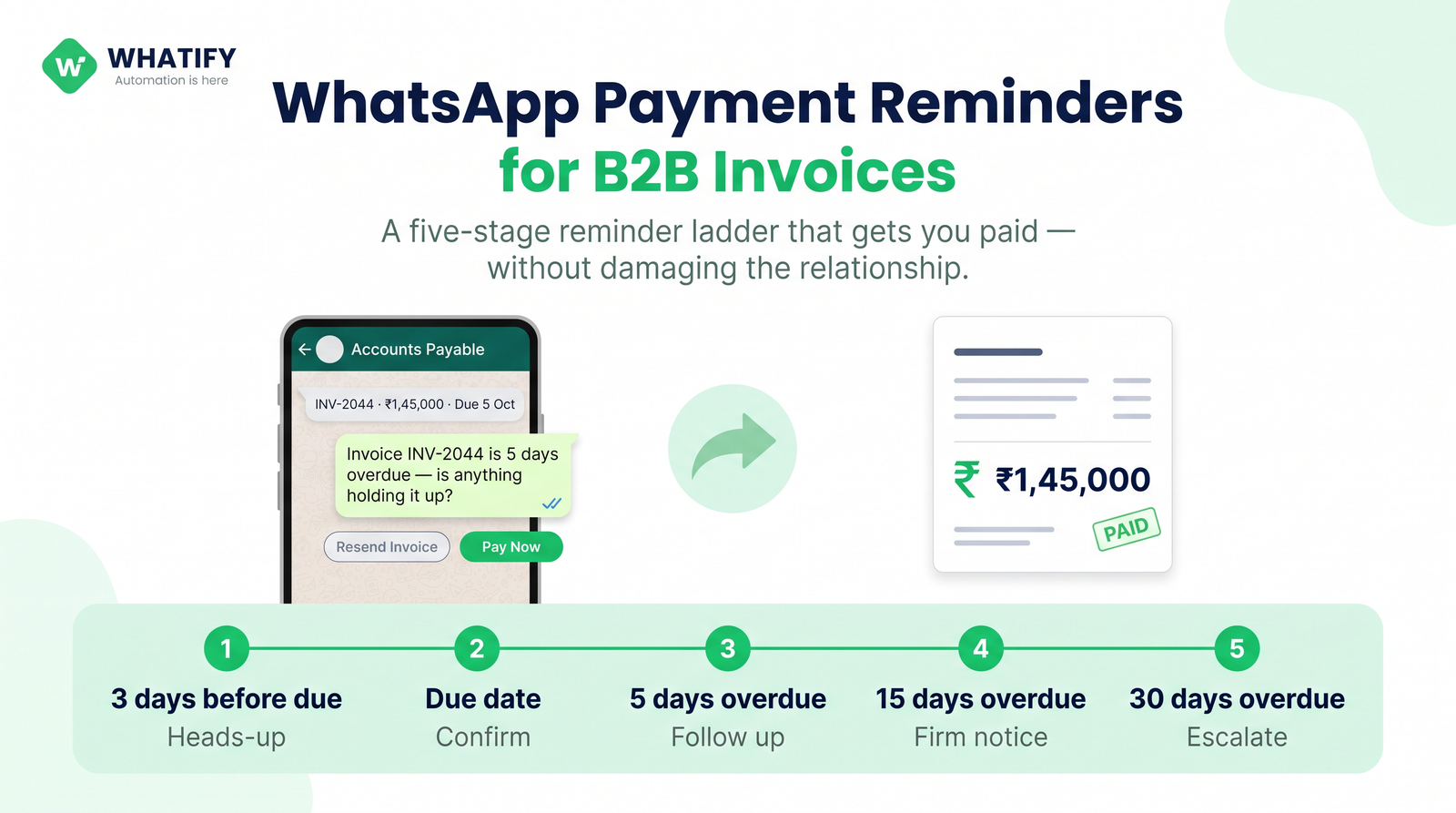
Escalation should be predictable and gradual. Tone hardens; volume does not.
|
Stage |
Timing |
Purpose |
|
1 |
3 days before due |
Neutral heads-up with amount and date |
|
2 |
On due date |
Confirmation that payment is due today |
|
3 |
5 days overdue |
Polite follow-up, ask if anything is blocking it |
|
4 |
15 days overdue |
Firmer, restate terms, name a resolution date |
|
5 |
30 days overdue |
Formal notice, move to phone and written escalation |
Stage 3 is the one most businesses skip, and it recovers the most. A large share of late payments are administrative — the invoice never reached AP, a PO number is missing, an approval is sitting with someone on leave. Asking "is anything blocking this?" surfaces that; a demand does not.
Get the template category right
Payment reminders about a specific transaction are transactional and belong in the utility category. They are also cheaper than marketing. Miscategorising them as marketing costs more and, more importantly, means a customer who has turned off marketing messages may never receive them.
Our guide to template categories covers the boundary, and rejection reasons covers what gets refused.
Write for the person, not the ledger
Include in every reminder: invoice number, amount, due date, and how to pay. Omitting any of these guarantees a reply asking for it.
Keep it short and unambiguous:
"Hi Rajesh — invoice INV-2044 for ₹1,45,000 was due on 5 October and is now 5 days overdue. Is anything holding it up at your end? Payment details are in the invoice, and I can resend it if useful."
Never use guilt, public pressure, threats of exposure, or messages to anyone outside the agreed contact. Beyond being ineffective, aggressive or coercive collection contact carries real legal exposure in India. Reminders should be factual, addressed to the right person, and sent at reasonable hours.
Make paying easy in the message
Every reminder should carry the payment route — a payment link, UPI details or bank particulars as agreed. Every extra step between reading and paying adds days.
A "Resend invoice" button removes the most common excuse entirely.
Automate the schedule, keep humans on the replies
The reminder schedule should trigger automatically from invoice status so nothing depends on someone remembering. Whatify integrates with Google Sheets and supports webhooks and API triggers — see features — so reminders can fire from an existing invoice tracker.
Replies must reach a person. A client explaining a delay and receiving an automated response is worse than no message. Route incoming replies into a shared team inbox where finance can see and answer them.
Stop the sequence the moment payment lands. Chasing a settled invoice damages more goodwill than the reminder ever recovered.
Cost
Utility-category messages are the cheapest business-initiated type. Five reminders across an invoice cycle is a small cost against the working capital recovered — current rates are published, and note that from 1 October 2026 replies within the customer service window are also chargeable.
Track two numbers
Days sales outstanding before and after introducing the ladder, and the stage at which payment typically arrives. If most payments land at stage 4, your early reminders are too soft. If stage 1 clears most invoices, you may be sending too many later stages.
Start a free trial and automate the first stage against your current overdue list.
Legal note: this article describes communication practice, not legal advice on debt recovery. Take professional advice before formal escalation.
EXTERNAL SOURCES
1. Meta — Template categorization: why transactional reminders fall under utility. https://developers.facebook.com/docs/whatsapp/updates-to-pricing/new-template-guidelines
2. Meta — WhatsApp Business Messaging Policy: prohibited conduct in business-initiated messaging. https://business.whatsapp.com/policy
3. Meta — Pricing: utility category rates and the October 2026 service message change. https://developers.facebook.com/docs/whatsapp/pricing
Frequently Asked Questions
Yes, using approved utility-category templates to a contact who has agreed to the channel. Agree at onboarding that invoices and reminders come via WhatsApp, capture the accounts payable contact rather than only your day-to-day contact, and send the first invoice through the channel.
Utility, because the message relates to a specific existing transaction. This is also cheaper than marketing, and it matters practically — a customer who has turned off marketing messages may never receive a reminder that was miscategorised as promotional.
A five-stage ladder works well: three days before due, on the due date, five days overdue, fifteen days overdue, then thirty days overdue with escalation to phone and formal written notice. Tone hardens gradually while message volume stays low.
Invoice number, amount, due date, how many days overdue if applicable, and the payment route. Add a resend option for the invoice itself. Omitting any of these guarantees a reply asking for it, which adds days to collection.
Avoid guilt, threats, public pressure and any contact with people outside the agreed recipient. Beyond being ineffective, aggressive or coercive collection contact carries legal exposure in India. Keep reminders factual, correctly addressed and sent at reasonable hours.
Track days sales outstanding before and after introducing it, and record which stage payment typically arrives at. If most payments land at stage four, the early reminders are too soft. If stage one clears most invoices, later stages may be unnecessary.
Ready to automate your WhatsApp marketing?
Start your 14-day free trial today. No credit card required.
Start Free Trial