WhatsApp Lead Qualification: Build a Reliable Sales Handoff
Turn inbound enquiries into structured sales handoffs with fewer questions, defined routing and a visible next step for every lead.
WhatsApp lead qualification uses a short conversation to identify a prospect’s need and collect the information sales requires. A reliable flow records relevant answers, assigns an owner and explains the next step. Keep human help available and avoid treating every reply as a sales-ready opportunity.
Define qualification before building the flow
A lead is not qualified because they clicked an ad or sent “Hi.” Sales and marketing need a shared definition. For a B2B service, useful signals could include business need, team size, timeframe and willingness to speak with sales. These are examples, not universal scoring rules.
Ask sales which missing details cause the most rework. Pick only the questions needed for a meaningful first conversation. If the team cannot explain why a field changes the next step, remove it from the opening exchange.
Write a short conversation, not a form in disguise
Open with a helpful choice: “Are you exploring a new setup, improving an existing process, or looking for support?” This separates buyers from customers who need assistance. Follow with one question at a time and offer clear button choices where appropriate.
A sample inbound flow is: intent → business need → team-size band → preferred next step. Explain why you ask for information. Do not request sensitive identifiers or unnecessary personal data. Let the customer skip a non-essential question or ask for an agent.
Decide what each answer changes
Routing rules should be understandable to the people maintaining them. A new sales enquiry can go to the sales queue; an existing customer issue should go to support. If territory determines ownership, collect the territory explicitly instead of guessing from a phone number.
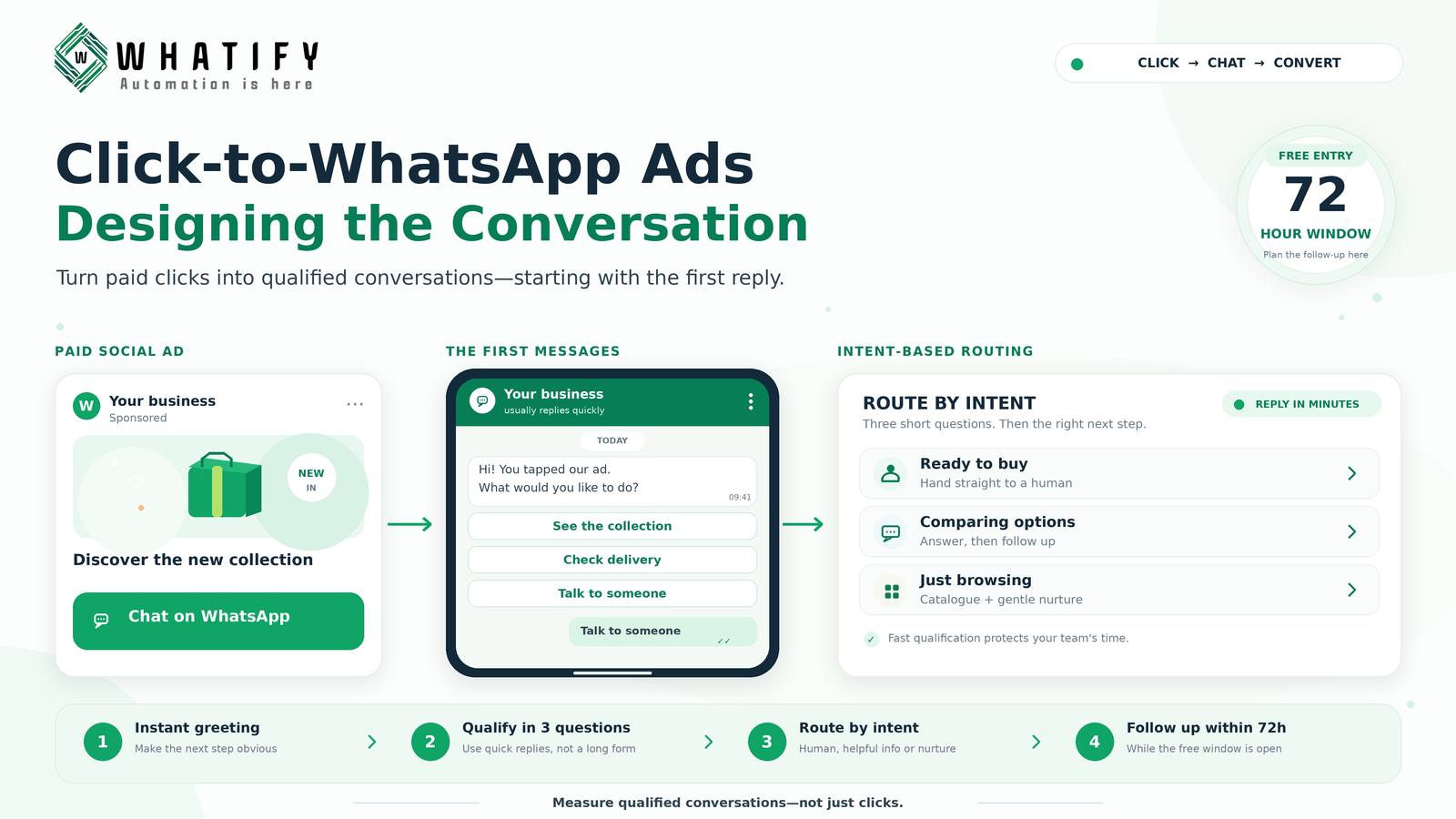
Whatify lists validated questions, conditions, custom contact attributes and agent assignment among its features. Test that answers are retained correctly and that the assigned agent sees them. For the acquisition side, use the existing guide to what happens after a Click-to-WhatsApp ad.
Make the handoff useful for both sides
The agent should receive a compact summary: reason for contact, essential answers, previous steps and promised follow-up. Use internal notes where suitable. The customer should receive a clear statement of what happens next, without an unstaffed promise of an immediate call.
An illustrative handoff message is: “Thanks. I’ve captured your requirement for a multi-agent WhatsApp setup. Our sales team will review it during business hours. You can also ask a question here.” Adapt it to actual staffing and response commitments.
Build recovery paths before launch
Test blank answers, unexpected free text, repeat enquiries and requests for a person. A fallback that repeats the same question indefinitely is not a qualification system. After an unsuccessful attempt, offer a direct human route or another contact option.
If an integration fails, preserve the conversation in the inbox and give the team a recovery task through the tools you have configured. Do not tell a customer a record was created unless the receiving system confirms success. Browse practical chatbot flow examples for adjacent journeys.
Measure whether sales receives better enquiries
Track completion rate, qualified handoffs and sales acceptance. Define acceptance as an agent confirming the enquiry meets the agreed criteria, not simply opening the chat. Review a sample of declined handoffs to find questions that produce misleading answers.
Compare outcomes by acquisition source. A campaign with many low-intent enquiries may need a different opening message rather than more follow-ups. Respect opt-outs and obtain appropriate permission before subsequent outreach.
Explore Whatify’s flow builder and inbox and test the full journey with sample contacts before sending live traffic.
Frequently Asked Questions
WhatsApp lead qualification uses a short conversation to identify a prospect’s need and collect the information sales requires. A reliable flow records relevant answers, assigns an owner and explains the next step. Keep human help available and avoid treating every reply as a sales-ready opportunity.
Ask only what changes routing or the next sales step. Common examples are business need, team size and preferred follow-up. Avoid sensitive identifiers and unnecessary personal data.
Hand over when the prospect meets your documented criteria, requests a person or reaches a point that needs human judgement. Include context so they do not repeat every answer.
It can collect information and route enquiries, but salespeople still handle judgement, negotiation and exceptions. Treat automation as preparation for a better conversation.
Measure sales acceptance and subsequent opportunity progression alongside completion rate. A large number of completed chats does not necessarily indicate high-quality leads.
Ready to automate your WhatsApp marketing?
Start your 14-day free trial today. No credit card required.
Start Free Trial